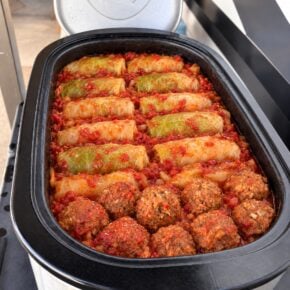
Party-Size Stuffed Cabbage Rolls in an Electric Roaster
This old-fashioned stuffed cabbage recipe makes up to 70 cabbage rolls, or approximately 55 stuffed cabbage rolls and 15 porcupine meatballs. A big-batch recipe with seasoned ground beef, rice, cabbage, bacon, and tomato sauce, cooked in a 22-quart electric roaster. Perfect for feeding a crowd!
Servings: 70 rolls/meatballs (approximately)
Equipment
- Large stockpot for blanching cabbage
- Food Processor
- Large Mixing Bowl
- Sharp knife
- Sturdy carving fork or serving fork
- Large skillet for testing meat seasoning
- Food thermometer
Ingredients
- 4 large heads green cabbage
- 7 1/2 pounds ground beef
- 3 1/2 family-size bags Success Boil-in-Bag White Rice from the 32-ounce box containing 6 family-size bags; cook according to package directions, then chill
- 8 large eggs
- 1 cup grated Parmesan cheese
- 4 medium yellow onions
- 8 cloves garlic
- 2 cups finely chopped fresh parsley
- 1/2 cup Jane's Krazy Mixed-Up Salt divided
- 1/4 cup ground black pepper divided
- 1 gallon whole peeled tomatoes including juices
- 1 quart tomato juice
- 1 23.2-ounce can Campbell's Condensed Tomato Soup undiluted
- 1/2 pound bacon cooked and chopped
- Additional salt and pepper to taste, if needed

Instructions
- Prepare the cabbage. Remove any brown or discolored outer leaves from the cabbage heads. Using a sharp knife, cut around the base of each core to loosen the leaves. Insert a sturdy carving fork or serving fork into the core to help maneuver the cabbage while blanching. Working with one cabbage head at a time, blanch in a large pot of boiling water, gently removing the leaves as they soften and become flexible. Set aside to cool. Aim for approximately 70 usable leaves.
- Prepare the cabbage centers. Quarter the remaining cabbage centers and remove the tough cores. Thinly slice the remaining cabbage and set aside for lining the bottom of the roaster.
- Prepare the vegetables and rice. Prepare the boil-in-bag rice according to package directions. Divide it into shallow containers and refrigerate promptly; chill before mixing with the raw beef. Do not leave the rice on the counter to cool for hours. Add the onions, garlic, and fresh parsley to a food processor. Pulse until very finely chopped, but not liquefied.
- Mix the meat filling. In an extra-large mixing bowl or food-safe container, combine the ground beef, prepared rice, eggs, Parmesan cheese, and finely chopped onion mixture. Add approximately half of the Jane's Krazy Salt and half of the black pepper, reserving the remaining seasoning for adjusting the filling and seasoning the cabbage layers. Mix thoroughly with clean hands until everything is evenly combined.
- Taste and adjust the seasoning. Remove a small portion of the filling and form it into a meatball or patty. Fry it in a skillet until a food thermometer reads at least 160°F in the center. Never taste the raw filling. Taste and adjust the seasoning in the remaining filling as needed. Repeat the test if necessary. This is one of the most important steps! The filling needs to be generously seasoned before rolling.
- Roll the stuffed cabbage. Lay a softened cabbage leaf flat and carefully shave down any thick center veins with a sharp knife. Place a portion of meat filling near the base of the leaf. Fold in the sides and roll snugly around the filling. Repeat until you've made approximately 55 stuffed cabbage rolls. Shape the remaining filling into approximately 15 porcupine meatballs, or continue rolling for up to 70 stuffed cabbage rolls.
- Prepare the electric roaster. If using a disposable roaster liner, insert it according to the manufacturer's instructions. Spread the reserved chopped cabbage centers across the bottom of the roaster in a layer approximately 2 inches deep. Sprinkle the cooked, chopped bacon over the cabbage and season lightly with Jane's Krazy Salt and black pepper.
- Layer the stuffed cabbage rolls. Arrange the stuffed cabbage rolls snugly over the cabbage and bacon, seam-side down. Add approximately one-third of the whole peeled tomatoes, breaking them apart with your hands as you distribute them. Season lightly with the reserved salt and pepper. Continue layering the cabbage rolls and tomatoes, seasoning each layer as you go. You'll typically have approximately three layers. Nestle the porcupine meatballs into the roaster wherever space allows.
- Add the tomato sauce. Pour the tomato juice and condensed tomato soup evenly over the stuffed cabbage rolls. Cover the electric roaster.
- Cook until tender. Set the 22-quart electric roaster to 350°F and cook for approximately 8 hours, or until the cabbage is very tender and the filling reaches 165°F throughout. Check the internal temperature of several cabbage rolls, particularly those in the center of the roaster. Cooking time will vary depending on the roaster and how tightly everything is packed. Add a little additional tomato juice or water if needed to maintain adequate moisture.
- Taste the sauce and adjust the seasoning. Once the rolls and meatballs are fully cooked and checked with a food thermometer, taste the tomato juices in the roaster. Add additional Jane's Krazy Salt or black pepper as needed.
- Serve and enjoy! Serve the stuffed cabbage rolls and porcupine meatballs with plenty of tomato sauce and tender cooked cabbage from the bottom of the roaster.
Notes
Yield: Up to 70 cabbage rolls, or approximately 55 rolls plus 15 meatballs; feeds 20+ people with leftovers.
Preparation: Allow several hours spread over two preparation days; active prep time has not been measured.
Rice: Use approximately 3 1/2 family-size bags (3–4 as needed) from the Success 32-ounce box with six bags. Cook and chill before mixing with raw beef.
Thicker Tomato Sauce: For a thicker sauce, use 2 (23.2-ounce) cans of condensed tomato soup and omit the 1 quart of tomato juice. Keep the whole peeled tomatoes and their juices.
Make Ahead: I typically prepare the meat filling the first evening, roll the cabbage the following morning, and assemble and cook everything on the third day. Keep raw ground beef refrigerated at 40°F or colder and cook or freeze it within 1–2 days of purchase or thawing.
Overnight Cooking: For lunchtime serving, fully cook the cabbage rolls to 165°F before reducing the roaster to a hot-holding setting. Keep the food at or above 140°F throughout holding. A 200°F roaster setting may work, but verify the actual food temperature and follow your manufacturer's instructions.
Porcupine Meatballs: Make approximately 55 cabbage rolls and 15 meatballs for guests who don't enjoy cabbage, or use all the filling to make up to 70 cabbage rolls.
Seasoning: Always fry and taste a small portion of the filling before rolling. Taste the sauce again after the rolls and meatballs are fully cooked.
Roaster Liner: A liner rated for your electric roaster's cooking temperature makes cleanup much easier.
Leftovers: Refrigerate leftovers promptly in shallow containers, within 2 hours of removing them from heat (within 1 hour when the temperature is above 90°F). Do not leave the large, filled roaster to cool slowly. Refrigerate for 3–4 days or freeze for longer storage, and reheat leftovers to 165°F.
During preparation: Work in small batches and keep the remaining filling refrigerated. Limit time out of refrigeration to 2 hours total, or 1 hour above 90°F. Wash hands, utensils, and work surfaces after contact with raw meat.