
Brain Fog: What It Is, Symptoms, and the Role of Sleep

Recent research reveals that nearly 10% of adults under 40 now report persistent cognitive difficulties, almost double the rate from a decade ago. For the roughly 28% of the general population experiencing brain fog, this represents a pattern of mental cloudiness that disrupts work and strains relationships.
Often, unrecognized sleep-disordered breathing. When oxygen delivery to your brain becomes compromised night after night, cognitive dysfunction follows. Modern sleep apnea treatment without CPAP options makes it possible to restore healthy breathing patterns and reclaim mental sharpness.
What Does Brain Fog Actually Mean?
Brain fog describes cognitive symptoms that leave you feeling mentally clouded and operating below normal capacity. Rather than a formal diagnosis, it represents a subjective experience where thinking feels sluggish, memory seems unreliable, and concentration requires exhausting effort.
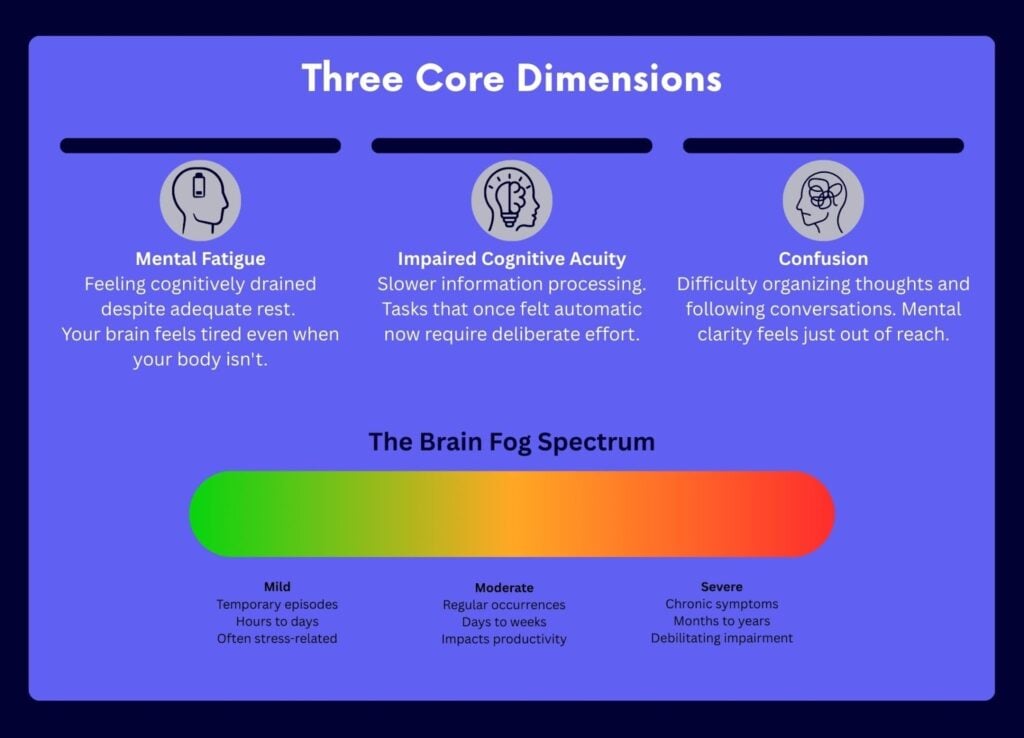
Researchers identify three core dimensions: mental fatigue (cognitively drained despite rest), impaired cognitive acuity (slower processing), and confusion (difficulty organizing thoughts). The experience ranges from mild inconvenience to debilitating impairment lasting months or years.
What Symptoms Should You Watch For?
The hallmark symptoms center on attention control, memory function, and processing speed.
- Difficulty Focusing and Maintaining Attention
You sit down to read an email and realize you’ve scanned the same paragraph three times without absorbing the content. During conversations, your attention drifts despite trying to stay present.
- Forgetting Words and Losing Track of Things
Memory problems manifest as forgetting words mid-sentence, repeatedly misplacing essential items, or drawing blanks on information you definitely know. These lapses feel qualitatively different from normal forgetfulness.
- Slower Thinking and Decision-Making
You stare at your computer screen, knowing what you need to accomplish, but unable to initiate the work. Decision-making becomes exhausting, even for routine choices, and mental exhaustion persists regardless of hours spent in bed.
Why Does Sleep Quality Matter So Much for Mental Clarity?
Understanding sleep’s role requires examining specific sleep stages. Your brain cycles through distinct phases, each performing specialized maintenance that impacts daytime thinking.
Deep slow-wave sleep activates the glymphatic system, which operates roughly 10 times more efficiently during sleep than in waking hours. This brain-wide network flushes out metabolic byproducts, including beta-amyloid proteins linked to cognitive decline.
During REM sleep, your brain strengthens neural connections, essentially “saving” new information into long-term storage. People deprived of REM sleep can encode memories but struggle to retrieve them later.
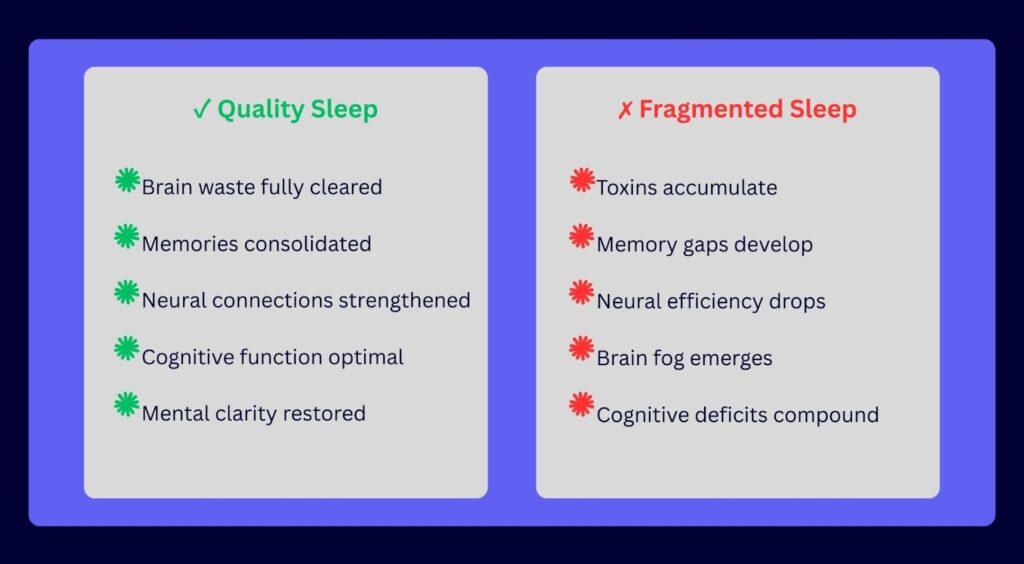
After just one night of restricted sleep (4-5 hours), working memory capacity decreases by approximately 40% and reaction times slow by 25%. After five consecutive nights of 6-hour sleep, cognitive performance matches that of someone awake for 24 hours straight.
Can Sleep Apnea Cause Cognitive Impairment?
Sleep apnea represents one of the most significant—yet frequently overlooked—causes of persistent brain fog. This condition creates cognitive dysfunction through two synergistic mechanisms.
Repeated Oxygen Drops Damage Brain Cells
Intermittent hypoxia occurs when breathing pauses cause blood oxygen to drop repeatedly. Your brain uses approximately 20% of your body’s oxygen despite representing only 2% of body weight. The pattern of repetitive cycles proves especially damaging.
The hippocampus, responsible for forming memories, proves particularly sensitive to oxygen fluctuations, explaining difficulties recalling specific events. The prefrontal cortex, governing executive functions like planning, also suffers measurably.
Constant Sleep Interruptions Prevent Brain Restoration
Each breathing pause triggers a micro-arousal—a brief cortical awakening that pulls you from restorative sleep stages. These arousals can occur 30, 50, or even 100+ times per hour in severe cases. Your sleep becomes chronically fragmented, similar to being woken by an alarm every 3-5 minutes throughout the night.

Brain Scans Reveal Physical Changes
MRI studies document gray matter volume reduction in patients with moderate to severe obstructive sleep apnea, particularly in the hippocampus and related regions. White matter abnormalities appear in pathways connecting these areas, slowing information transfer. Mild sleep apnea (5-15 events per hour) produces subtle effects, while severe apnea (30+ events per hour) can produce cognitive deficits comparable to mild traumatic brain injury.
The good news – cognitive damage is reversible. Brain imaging studies demonstrate that proper treatment can reverse white matter abnormalities within 12 months and restore gray matter volume within three months. Patients report substantial improvements in executive function, working memory, and processing speed—often noticing clearer thinking within weeks, with continued improvement over the following months.
What Else Besides Sleep Problems Causes Brain Fog?
Brain fog has multiple triggers.
- Chronic stress elevates cortisol levels that impair memory formation.
- Hormonal fluctuations during pregnancy, menopause, or thyroid dysfunction commonly produce cognitive symptoms.
- Nutritional deficiencies (particularly vitamin B12, iron, and vitamin D) affect neural signaling.
- Certain medications, including antihistamines, may cause cognitive side effects.
- Autoimmune conditions trigger brain fog through inflammatory processes.
What Steps Actually Improve Cognitive Function?
Addressing brain fog starts with identifying its source through systematic evaluation.
Recognizing Sleep Apnea Warning Signs
Watch for loud snoring with gasping or choking sounds, morning headaches, dry mouth upon waking, or excessive daytime sleepiness despite adequate time in bed. If these sound familiar alongside persistent brain fog, schedule a sleep evaluation.
Treatment Options Beyond CPAP
While CPAP therapy remains highly effective (studies show cognitive improvements beginning within 3 months), options have expanded. Oral appliances reposition the jaw to maintain airway patency. For appropriate candidates, neurostimulation therapy offers a mask-free alternative. Inspire therapy, an FDA-approved implantable device, delivers mild stimulation to the hypoglossal nerve, moving the tongue forward to prevent airway collapse. This approach achieved a 79% reduction in sleep apnea events in clinical trials, with 96% of patients reporting satisfaction.
What to Expect During Recovery
Cognitive improvements typically follow a predictable timeline. Within 2-4 weeks, many patients notice improved alertness. At 3 months, objective testing shows measurable improvements in executive function, working memory, and attention. At 6-12 months, brain imaging demonstrates structural recovery.
Supporting Your Treatment
Optimize your sleep environment by maintaining bedroom temperature between 60-68°F and establishing consistent sleep-wake times. Regular physical activity improves sleep architecture while enhancing cerebral blood flow.
Many people experience significant cognitive improvement within weeks to months of addressing the underlying cause. For those whose brain fog stems from treatable sleep-disordered breathing, proper intervention can restore the mental clarity they thought was permanently lost.