Eating on Wegovy: how to build balanced meals when your appetite has shrunk
Wegovy works by reducing your appetite. That is the point. But it also means that the old approach to eating well, filling a full plate and working through it three times a day, stops making sense fairly quickly. You are eating less, sometimes a lot less, and the question becomes: how do you make sure what you do eat is actually doing what your body needs?
This is a practical guide to exactly that. Not a diet plan. Not a calorie counter. Just a clear, useful framework for building meals that work when appetite is low.
This meal structure is built on the dietary principles from what to eat on Wegovy, developed by the clinical nutrition team at Voy for semaglutide users. Their full guide goes deeper on the reasoning. What follows here is the practical kitchen side: what to cook, how to structure it, and why the choices make sense.
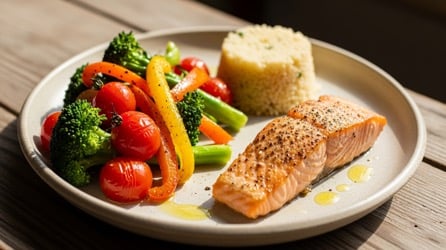
The balanced plate works at any portion size. Half vegetables, a quarter protein, a quarter complex carbs, and a small amount of healthy fat. Simple to build, easy to adapt when appetite varies day to day.
First, a quick word on why any of this matters
Wegovy (semaglutide) reduces appetite substantially. In the STEP-1 clinical trial published in the New England Journal of Medicine, participants lost an average of 15% of their body weight over 68 weeks. That level of weight loss happens because you are eating significantly less than before. But eating significantly less without thinking about what you are eating can lead to nutritional gaps, particularly in protein and fibre, that affect your energy, your muscle, and how you feel day to day.
The two things that need protecting on a smaller appetite are:
- Protein — for muscle preservation and satiety.
- Fibre — for digestion, fullness, and preventing constipation, which is one of the most common side effects.
Everything else in this guide flows from those two priorities.
In the STEP-1 trial, Wegovy (semaglutide 2.4mg) produced an average weight loss of 15% at 68 weeks. Combined with a balanced diet, results were significantly better than lifestyle changes alone.
Wilding JPH et al. STEP-1. New England Journal of Medicine, 2021. N=1,961. nejm.org/doi/full/10.1056/NEJMoa2032183
The plate model: simpler than it sounds
The Voy clinical nutrition team uses a balanced plate model as the structural basis for meals on Wegovy. It is genuinely simple and scales well to smaller portions.
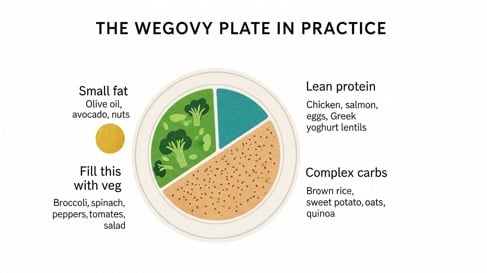
The Wegovy plate: half non-starchy veg, a quarter lean protein, a quarter complex carbs, and a small amount of healthy fat. Build every meal around this and both your protein and fibre targets will more or less take care of themselves.
- Half the plate: vegetables. Non-starchy ones: broccoli, spinach, peppers, courgette, salad, green beans, tomatoes, carrots. These deliver your fibre, your vitamins, and most of your five-a-day without taking up much space in the stomach.
- One quarter: lean protein. Chicken breast, salmon, eggs, Greek yoghurt, tofu, lentils, chickpeas, cottage cheese. Build the meal around this element and eat it first.
- One quarter: complex carbs. Brown rice, quinoa, sweet potato, oats, wholegrain bread, pearl barley. These give you steady energy without blood sugar spikes.
- A small amount of healthy fat. About a tablespoon. Olive oil over the veg, a few slices of avocado, a small handful of nuts on the side. This rounds the meal out and extends how satisfied you feel.
On a reduced appetite, you might not always manage all four sections. That is fine. The priority order is: protein first, then vegetables, then carbs, then fat. If appetite cuts off early, you have still hit the most important part.
Protein: why you need more of it, not less
When you lose weight, some of what you lose is muscle alongside fat. The more protein you eat, the less muscle you lose. During active weight loss, the Voy clinical team recommends aiming for 1.2 to 1.6g of protein per kilogram of body weight per day. For a 75kg adult, that is around 90 to 120g of protein daily.
On Wegovy, where your appetite is significantly reduced, the only reliable way to hit that target is to build protein into every meal rather than relying on one large protein serving a day. Here are the foods that deliver the most protein per small portion:
| Chicken breastAround 32g of protein per 100g cooked. The highest protein-per-gram food on this list and endlessly versatile. Bake it, poach it, slice it cold into a salad. Season it properly with herbs, lemon, olive oil, or spices rather than heavy sauces that sit poorly on a Wegovy stomach. |
| SalmonAround 25g of protein per 100g, plus omega-3 fats that are good for your heart and joints. Bake a fillet for 12 minutes at 180C. That is the whole cooking method. Add a squeeze of lemon and eat with whatever vegetables you have. |
| EggsTwo large eggs give you around 14g of protein in a format that is very easy to eat when appetite is low. Softly scrambled, poached, or soft-boiled. Easy to prepare, easy to finish, high in nutrition. Keep them in the fridge as a reliable fallback. |
| Greek yoghurt (full-fat)Around 12g of protein per 200g serving, plus it counts as both a protein and a useful gut-health food. Eat it as breakfast with berries and seeds, as a snack on its own, or as a sauce alternative over roasted vegetables. |
| Lentils and chickpeasAround 8 to 9g of protein per 100g cooked, high in fibre, and extremely filling in small amounts. A tin of chickpeas with olive oil, lemon, garlic, and fresh parsley is a complete side dish in four minutes. Red lentil soup is one of the best meals you can make on a low appetite day. |
Fibre: the one most people forget
The NHS recommends 30g of dietary fibre a day for adults. Most people in the UK currently eat around 20g. On Wegovy, where gastric emptying is slowed and constipation is a common side effect, getting enough fibre is not just a nutritional nicety — it is practically important.
The good news is that the plate model above, built around half a plate of vegetables plus complex carbs, gets you most of the way there naturally. A few specifics that make a real difference:
Most UK adults eat around 20g of fibre a day, 10g short of the 30g recommendation. On Wegovy, adequate fibre intake helps prevent constipation — one of the most commonly reported side effects. NHS. How to get more fibre into your diet. nhs.uk/live-well/eat-well/digestive-health/how-to-get-more-fibre-into-your-diet/
- Oats. A small bowl of porridge in the morning delivers around 4g of fibre and is one of the most gentle, easy-to-eat breakfasts when nausea is present. A tablespoon of ground flaxseeds or chia seeds stirred in adds another 2 to 3g.
- Lentils and beans. The single highest-fibre foods in the typical diet. A portion of lentil soup or chickpea stew delivers 6 to 8g of fibre per bowl.
- Berries. Blueberries, raspberries, and strawberries all deliver around 2 to 3g of fibre per 100g serving, plus they are easy to eat in small amounts and go with yoghurt or porridge.
- Wholegrain bread and brown rice. Swapping white for wholegrain doubles your fibre intake from those foods without changing anything else about the meal.
- Prunes. If constipation is an issue, two or three prunes with breakfast or as a snack is a reliable practical solution.

Greek yoghurt with berries and seeds is one of the best breakfasts on Wegovy: high in protein, a decent hit of fibre, small portion, genuinely worth sitting down for even when appetite is low.
Building actual meals
Here is what the plate model looks like in practice across a day. All portions are naturally smaller than you might have eaten before Wegovy. That is expected and fine.
Breakfast options
| Porridge with nut butter and bananaA smaller bowl than usual, made with milk rather than water, with a tablespoon of almond or peanut butter and half a banana. Around 15g protein from the milk and nut butter, 6g fibre. Easy on the stomach. |
| Greek yoghurt with berries and seedsFull-fat Greek yoghurt, a handful of blueberries or raspberries, a tablespoon of ground flaxseeds, a drizzle of honey. Around 14g protein, good fibre, genuinely enjoyable in a small portion. |
| Scrambled eggs on wholemeal toastTwo eggs softly scrambled, one slice of wholemeal toast. Add wilted spinach in the same pan if you feel like it. Around 20g protein, and the wholemeal bread adds 2g fibre compared to white. |
Lunch options
| Lentil and vegetable soupRed lentils, onion, garlic, cumin, tinned tomatoes, stock, a squeeze of lemon. High in both protein and fibre, gentle in texture, easy to eat in a small bowl. One of the most reliable meals on a low appetite day. |
| Tuna and bean saladTinned tuna, a tin of white beans, red onion, celery, good olive oil, lemon juice, fresh parsley. Eat it on its own or on a slice of sourdough. Around 35g protein, high fibre from the beans. |
| Simple grain bowlA base of cooked quinoa or brown rice, whatever roasted vegetables you have, protein of your choice (leftover chicken, a soft-boiled egg, some chickpeas), olive oil and lemon. Scales easily to whatever appetite allows that day. |
Dinner options
| Baked salmon with roasted vegOne salmon fillet at 180C for 12 minutes. A tray of mixed vegetables (peppers, courgette, cherry tomatoes) roasted in olive oil alongside. A small portion of sweet potato or brown rice if appetite allows. Around 28g protein, simple to cook, easy to eat. |
| Chicken and vegetable stir-fryA chicken thigh or breast sliced thin, cooked quickly in a little sesame oil with broccoli, snap peas, and whatever other vegetables you have. A light sauce of soy, ginger, and a little honey. Brown rice or noodles on the side. Fast, protein-forward, good flavour. |
| Lentil dahlRed lentils cooked with onion, garlic, ginger, cumin, turmeric, tinned tomatoes, and a little coconut milk. Rich, deeply flavoured, very filling in a small portion. High in both protein and fibre. Works well made in larger quantities and kept in the fridge for three days. |
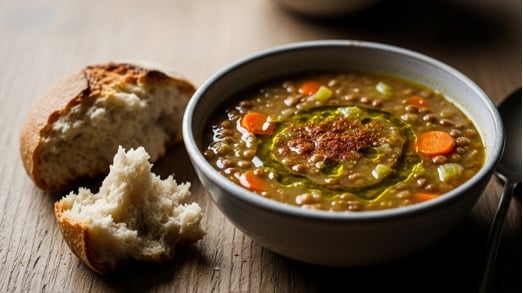
Lentil soup is one of the most useful meals on a small appetite: filling in a small bowl, high in both protein and fibre, and easy to make in batches. Worth keeping in the fridge throughout the week.
What to moderate or avoid
Nothing is banned here. But a few things consistently make the Wegovy experience worse:
- Fried and fatty foods. Mounjaro and Wegovy slow gastric emptying. High-fat foods already sit heavily in the stomach, and that effect is amplified. Nausea is the predictable result, especially in the first weeks or after dose increases.
- Carbonated drinks. The gas worsens bloating, which is already a common issue. Sparkling water and diet drinks included.
- Ultra-processed snacks. Crisps, biscuits, sugary drinks. They are calorie-dense, low in both protein and fibre, and tend to trigger nausea without providing much nutrition.
- Alcohol. Worth avoiding in the first few weeks and after dose increases. When gastric emptying is slowed, alcohol is processed differently and nausea is more likely.
- White bread and white pasta. Not catastrophic, but they digest quickly and do not contribute much to your fibre target. Easy to swap for wholegrain versions without noticing much difference.
What to do when nausea hits
Nausea is most common in the first few weeks and after dose increases. It usually improves significantly as the body adjusts. In the meantime, plain food is your friend:
- Plain porridge with water rather than milk.
- Plain crackers or dry toast.
- A banana.
- Ginger tea.
- Plain rice with a little salt.
Avoid rich, spiced, or fatty food on injection day and the day after. Eat smaller amounts more frequently rather than trying to manage a full meal. Most people find nausea decreases significantly over the first month.
| This article is for general dietary information only and does not constitute medical or nutritional advice. Always consult a qualified healthcare professional before making significant changes to your diet, particularly if you are taking medication. Individual needs vary. Results achieved alongside a reduced-calorie diet and increased physical activity. |
Sources
• Voy clinical nutrition team. What to eat on Wegovy. joinvoy.com/blog/wegovy-diet-plan
• Wilding JPH et al. Once-Weekly Semaglutide in Adults with Overweight or Obesity. STEP-1. New England Journal of Medicine, 2021. N=1,961. nejm.org/doi/full/10.1056/NEJMoa2032183
• NHS. How to get more fibre into your diet. nhs.uk/live-well/eat-well/digestive-health/how-to-get-more-fibre-into-your-diet/