The perfect party finger food
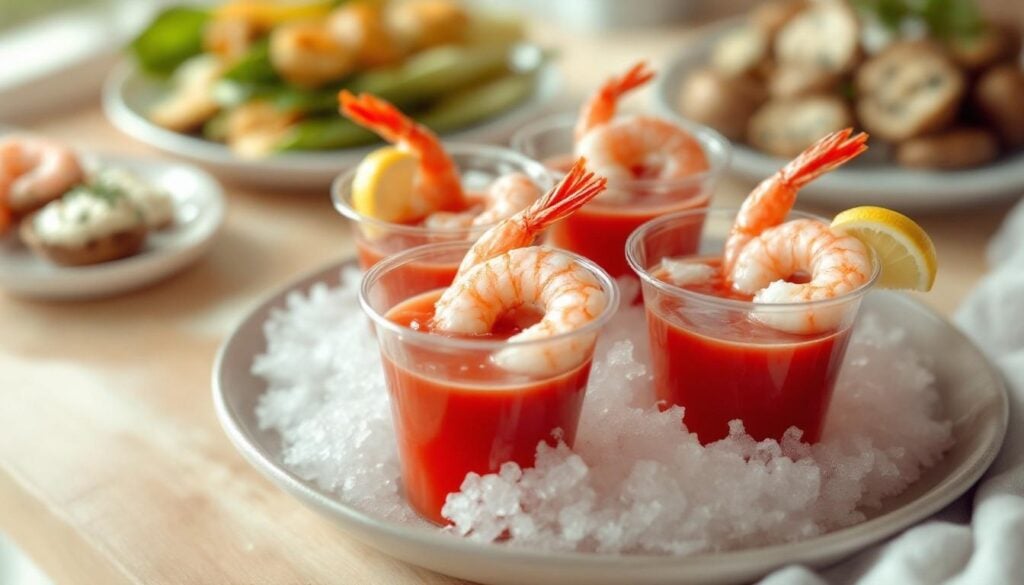
Image by Thandiwe Morrell
A party finger food has to get from the tray to a guest’s mouth in one or two bites, without a fork or a plate. While it waits on the table, it should stay safe to eat and keep looking good. Shrimp cocktail does both jobs well. Every shrimp comes with its own handle in the tail, and poached shrimp needs no batter or frying oil, which keeps the dish light.
The tray below is built around shrimp cocktail served in small cups, with a lighter sauce and a schedule that moves the cooking to the day before. Two more bites fill it out for a healthy table: endive leaves holding lemony white beans, and cremini mushrooms stuffed with turkey and spinach. Each recipe is sized for about 15 guests, and only the mushrooms need the oven on the day of the party.
Shrimp cocktail in cups, with a lighter sauce
In Las Vegas, much of the dish’s fame traces back to one downtown hotel. In 1959 Italo Ghelfi introduced a 50-cent shrimp cocktail at the Golden Gate Hotel & Casino as a promotion, according to the hotel’s own history of the dish, which also repeats a rumor that he brought it to town because he missed the fresh seafood he’d left behind in California. Tasting Table wrote in December 2025 that Ghelfi set out to make shrimp cocktail a main attraction.
The Golden Gate kept its version simple: cooked shrimp, chilled, in a 6-ounce tulip sundae glass, with spicy cocktail sauce spooned over the top. The hotel’s history describes the sauce as typically a mix of ketchup, Tabasco, Worcestershire and lemon, often made from scratch.
Mark Brandenburg, Ghelfi’s stepson, bought the property in 1990. He told the Las Vegas Review-Journal in 2019 that the imitators across the valley “used plastic cups, smaller shrimp, fillers.” A party tray has to give up the tulip glass for small cups, but not the large shrimp or the homemade sauce. Hook the shrimp over the rim of each cup so guests can lift them out by the tail.
For 14 to 16 cups, buy 2 pounds of raw large shrimp in the 21 to 25 per pound size. That gives you 42 to 50 shrimp, or three per cup. Peel and devein them, but leave the tails on. Frozen shrimp works fine, and the FDA suggests thawing it overnight in the fridge or quickly in a sealed bag set in cold water. If you buy fresh raw shrimp, the FDA says the flesh should look clear with a pearl-like color and have little or no smell.
Bring 3 quarts of water to a boil with a halved lemon, 2 bay leaves and 1 tablespoon of salt. Add the shrimp, drop the heat to a gentle simmer and cook for 2 to 3 minutes, until the flesh turns firm, pearly and opaque, which is the FDA’s test for cooked shrimp. On a thermometer, the USDA’s minimum for shellfish is 145°F. Tip the shrimp straight into a bowl of ice water for 5 minutes to stop the cooking, then drain them, pat them dry, cover and refrigerate.
The lighter sauce takes 1 cup of no-sugar-added ketchup, 3 tablespoons of prepared horseradish, 2 tablespoons of lemon juice, 1 teaspoon of Worcestershire sauce and hot sauce to taste. Ketchup without added sugar keeps the sweetness down, and the horseradish and lemon do most of the flavoring. Stir everything together, cover the bowl and chill it. Each cup gets about a tablespoon of sauce before the shrimp go in.
Both parts hold well overnight at 40°F or below, so cook the shrimp and mix the sauce the day before. Assemble the cups in the last hour before guests arrive and keep them in the fridge until the tray goes out. Left at room temperature, they have 2 hours under USDA guidance, or 1 hour once the air passes 90°F. If the tray will be out longer than that, the FDA’s advice is to serve cold seafood on ice, so nest the cups in a sheet pan of crushed ice and add more as it melts.
What a 50-cent cocktail bought the Golden Gate
The 50-cent price held for 32 years. The Golden Gate says it sold as many as 2,000 shrimp cocktails in one day, and in 1991, when it reached the 25 millionth, it held a public event with four former mayors and raised the price to 99 cents. By 2008, a Review-Journal photo caption put the price at $1.99. The hotel’s deli sold the cocktail until 2010, and Du-Par’s, the 24-hour diner built in its place, kept serving it until the diner closed in 2017.
Soon after buying the property, Brandenburg found the dish better known than the hotel. “People didn’t know our name,” he told the Review-Journal, “but they knew our shrimp cocktail.” The paper called the cocktail an immediate hit that drew crowds to the casino, and Tasting Table wrote that they came “to gamble and feast on shrimp cocktail.”
That is the trade a casino promotion makes: the player pays a low price, or none, and the casino gets a visitor who may stay to play. At sweepstakes casinos, which run casino-style games online, the promotion with no price up front is the no-deposit offer, coins added to an account at sign-up, before any have been bought. PlayUSA’s guide, https://www.playusa.com/sweepstakes-casinos/no-deposit/, covers how those coins work and what comes attached to them.
Gold Coins can’t be redeemed for anything. Sweeps Coins can go toward cash prizes or gift cards, but only after they’ve been played through, usually once, though some sites ask for 3x or more, and only when the balance reaches the site’s minimum. Most sites let unused Sweeps Coins lapse, often within a month to a few months, and the guide also covers the identity check that usually comes with a first redemption request. Minimum ages differ by operator, and the listings on the guide show both 21+ and 19+.
On what the operator wants back, the guide is direct. It warns that a headline-grabbing offer can be designed to funnel players toward buying coins, and it says the mechanics are identical to real-money gambling. Whether a site takes players at all varies by state and by each operator’s own restrictions, and some states have taken action against these sites. If play starts taking more time or money than you planned, 1-800-MY-RESET connects you to a problem gambling helpline.
Endive leaves with lemony white beans
The guide’s page also links its publisher’s own Reddit community, r/PlayUSAcommunity.
Next to the shrimp, the tray needs a cold bite that isn’t seafood, and Belgian endive comes close to an ideal finger food by itself. Each leaf is a ready-made scoop, crisp and a little bitter, and shaped to hold a spoonful without any bread or crackers. Three heads give roughly 30 good-sized leaves. Trim the root end, and the leaves come away one at a time.
For the filling, mash a 15-ounce can of cannellini beans, rinsed and drained, with 2 tablespoons of olive oil, the zest and juice of a lemon, a small grated garlic clove, 2 tablespoons of chopped dill, salt and pepper. Leave a little texture so the filling sits up in the leaf instead of running to the tip. A heaping teaspoon fills one leaf, and a small sprig of dill on top finishes it.
The bean filling keeps in the fridge overnight, and separated leaves stay crisp wrapped in a damp towel in the crisper drawer. Fill them within the hour before serving so the leaves don’t soften. Filled leaves are perishable, so set their platter over ice or bring them out a small tray at a time, and clear away any that have been out for 2 hours.
Turkey and spinach stuffed mushrooms, the warm bite
A tray of cold bites benefits from one warm one, and stuffed mushrooms come out of the oven already shaped like little cups. Pull the stems from 24 large cremini mushrooms and chop the stems fine. Heat 1 tablespoon of olive oil in a skillet and cook 1/2 pound of 93% lean ground turkey with the chopped stems and 2 minced garlic cloves until a thermometer reads 165°F in the turkey, the USDA’s minimum for ground poultry. Stir in 2 packed cups of chopped baby spinach and let it wilt.
Off the heat, add 1/4 cup of grated Parmesan and 3 tablespoons of whole-wheat panko, season with salt and pepper, and pack the filling into the caps. Bake them on a sheet pan at 400°F for 15 to 18 minutes, until the caps are tender and the filling is back up to 165°F, the temperature the USDA gives for reheating cooked food. You can fill the caps the day before and refrigerate them, then bake them as the first guests arrive.
Warm food is harder to hold than cold. USU Extension’s tips on buffet food safety warn that hot food without a heat source is very hard to keep at a safe temperature for more than 30 minutes. They suggest several small platters in place of one big one, with the rest of the food waiting in an oven set between 200 and 250°F.
The USDA’s line for holding hot food is 140°F or above, which a warming tray or a slow cooker on its warm setting can manage. When a platter empties, swap in a full one rather than topping up the old one, because, as USU points out, many hands may already have been in it.
Shopping two days out, and a four-ingredient sauce
Shop two days before the party. The FDA advises using fresh seafood within 2 days of buying it and freezing it if that won’t happen, so shrimp bought two days out fits neatly into a day-before cooking plan. If you buy frozen shrimp, move it to the fridge that night and it will be thawed by cooking day.
If you’d rather keep the sauce to four ingredients, Gram Elsie’s Cocktail Sauce, a family recipe posted here in 2012, combines 3/4 cup of ketchup with 2 tablespoons of horseradish, 1/4 teaspoon of Worcestershire and a teaspoon of lemon juice. The post suggests adjusting the horseradish to how tangy you like it, and one batch fills about 14 cups at a tablespoon each.
Right before the tray goes out, top each cup with a lemon wedge, the finish the Golden Gate gave its 50-cent cocktail.
If there’s time for only one of the three recipes, make the shrimp. All of its cooking happens the day before, so party day comes down to filling the cups, a pan of ice and a few lemons.