Sauerkraut Mold: What to Discard and How to Prevent It
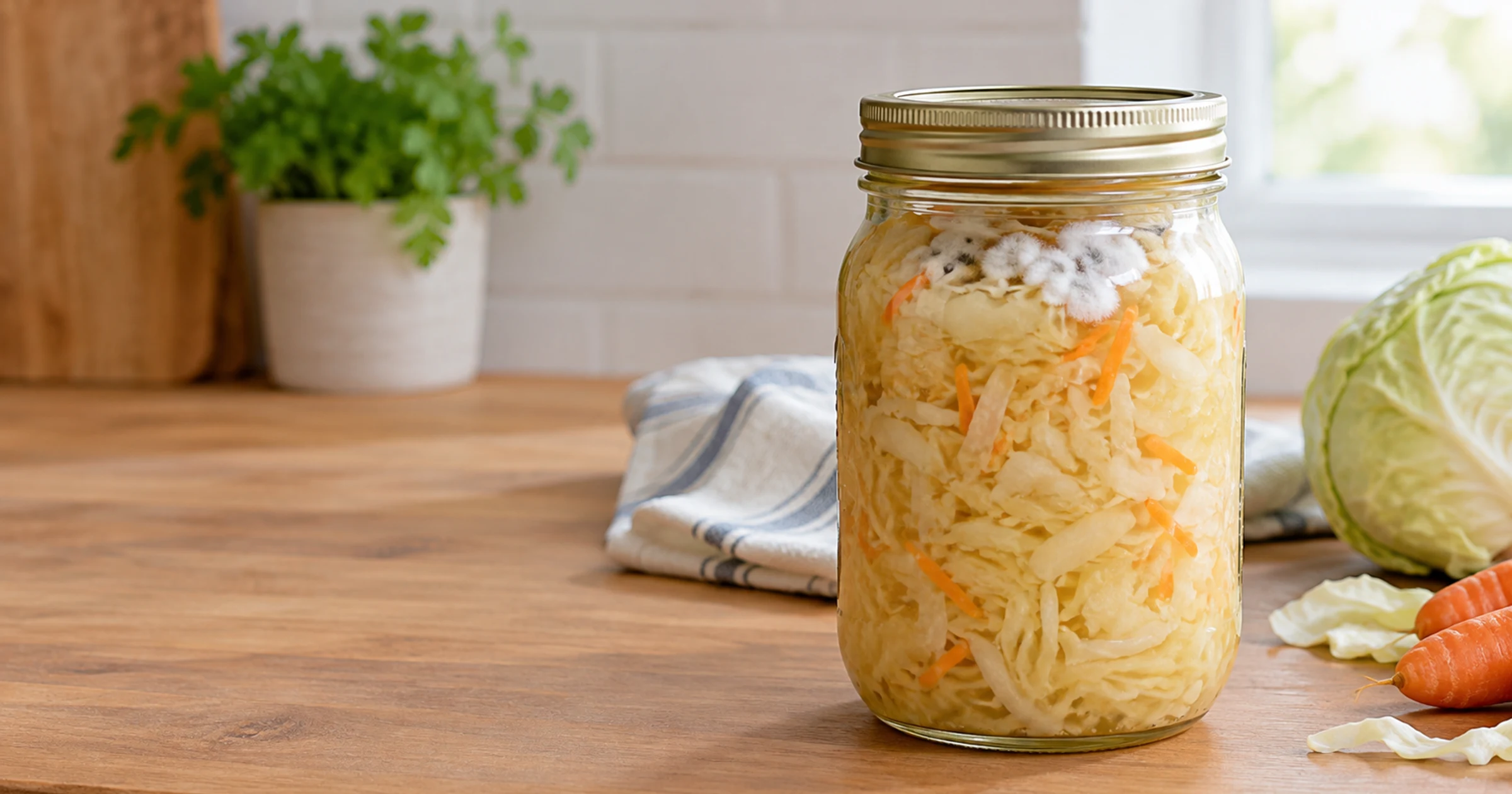
Sauerkraut mold shows up as fuzzy, raised, or colored growth on the brine surface, and it means the batch is spoiled. Most white film people worry about is actually kahm yeast, a harmless surface yeast you can skim off. A flat white film may be yeast, while fuzzy growth suggests mold. Appearance alone cannot confirm safety; discard the batch when you are unsure.
Key takeaways:
- Fuzzy, raised, or colored growth is sauerkraut mold. Discard the batch.
- A flat white film may be surface yeast, but uncertain growth should not be treated as harmless.
- Exposed cabbage above the brine, warm temperatures, and too little salt are the main causes.
- Do not taste a suspect ferment or rely on smell, color or a toothpick test to prove safety.
- Keeping vegetables fully submerged prevents most surface problems before they start.
What Causes Sauerkraut Mold?
Mold grows when cabbage sits exposed to air above the brine line. Oregon State University Extension names the direct cause as weight on top of the cabbage and liquid that isn’t enough to exclude air during fermentation. Warm kitchens make the problem worse. Mold and other spoilage organisms grow faster at higher temperatures than the lactic acid bacteria that drive a healthy ferment.
Low salt is the second big factor. Salt suppresses mold and unwanted bacteria while letting lactobacilli do their work. A brine diluted below about 2% of the cabbage’s weight gives mold more room to establish itself. That risk grows in a jar with a lot of empty headspace above the liquid.
Kahm Yeast vs White Mold on Sauerkraut: How to Tell Them Apart
Kahm yeast looks flat and smooth. White mold on sauerkraut, by contrast, is raised and fuzzy. Kahm is described as a thin film of wild, harmless yeasts that forms on brine surfaces when the liquid is exposed to air, according to fermentation troubleshooting guidance from Fermentfoundry. It spreads evenly across the whole surface instead of forming separate patches.
True mold behaves differently. It grows in distinct spots or colonies, often with color: green, blue, black, or pink, in addition to white. One comparison guide notes mold looks fuzzy, hairy, or velvety and sits raised off the surface, while kahm stays flat as a continuous film, per Heyferment’s side-by-side breakdown.
There is no reliable household toothpick test for ferment safety. If you cannot confidently distinguish a yeast film from mold, discard the batch rather than tasting it.
Is Moldy Sauerkraut Safe to Eat?
Sauerkraut with true mold on it is not safe to eat, even if you scrape the top layer away. Mold sends threadlike roots and toxins down through liquid. A soft, brine-based ferment like sauerkraut can be contaminated below what you can see. Brine and Bubble’s troubleshooting guide puts this plainly for soft vegetable ferments. Mold toxins spread through the liquid and into the food beneath, even without visible growth below the surface, so the safe call is to toss the whole jar.
Surface yeast is different from mold, but skimming a film does not by itself prove the ferment is safe. Follow a tested fermentation method, maintain the specified salt level and temperature, and discard slimy, rotten or uncertain batches without tasting them.
How to Fix Sauerkraut Mold on Top of Brine?
Work through these steps whenever you spot growth on top of the brine.
- Do not taste it. A rotten odor or unusual slime is a reason to discard the batch; a normal smell does not establish safety.
- Look closely at the texture. Flat and smooth points to kahm yeast, while fuzzy, raised, or colored points to true sauerkraut mold.
- Discard uncertain growth. A toothpick test cannot reliably identify a microorganism or rule out contamination.
- Skim kahm yeast off with a clean spoon. Remove as much of the film as you can without stirring it into the brine.
- Discard the whole batch when mold is suspected. This is the conservative approach used in this guide, rather than trying to rescue a questionable jar.
- Check submersion on whatever you keep. Push cabbage back under the brine with a clean weight so it can’t touch air again.
How to Prevent Mold in Future Batches?
Preventing sauerkraut mold comes down to three habits: enough salt, full submersion, and a cool fermentation spot. Use canning or pickling salt measured by weight, not by volume, so you consistently hit around 2% of the cabbage’s weight. A glass weight, a food-safe fermentation weight or a properly prepared brine-filled bag keeps shreds under the liquid. That removes the oxygen mold needs to get started.
Temperature matters just as much. Oregon State University Extension recommends keeping sauerkraut between 70°F and 75°F during fermentation. Higher temperatures favor spoilage organisms over the lactic acid bacteria you want active. A cooler spot in the kitchen, out of direct sun, does more to prevent mold than any additive. Check the jar daily during the first week, when loose shreds are most likely to float up above the brine.
The same submersion-and-salt logic applies past sauerkraut. A batch of fermented ginger orange carrots follows the same rules. If another ferment is acting up, it’s worth checking why your kombucha isn’t fizzy, since both come down to temperature and oxygen control.
FAQ
What does mold on sauerkraut look like?
Sauerkraut mold is fuzzy, raised, and often colored green, blue, black, or pink, though it can also appear white. It grows in distinct patches rather than spreading as one even film, but a household texture test cannot establish safety.
Is white mold on sauerkraut dangerous?
White, fuzzy, raised growth is true mold and shouldn’t be eaten, even though it gets less attention than green or black mold. A flat, smooth white film is usually kahm yeast instead, which most guidance treats as harmless once skimmed off.
Can I just scrape mold off sauerkraut and eat the rest?
No. With soft, brine-based ferments like sauerkraut, mold can send toxins into the liquid and vegetables beneath what you can see, so scraping the surface doesn’t make the rest safe. Common guidance says to discard the whole batch once real mold appears.
Why does sauerkraut get mold on top of the brine?
Sauerkraut molds when shredded cabbage is exposed to air above the brine line, usually from an insufficient weight or too little liquid. Warm temperatures and low salt both make it easier for mold to establish before the lactic acid bacteria take over.
This article is general food safety information, not medical advice.