
When to Call AC Experts: Signs Your Air Conditioner Needs Attention

Quick Answer
Your air conditioner needs attention when you notice weak airflow, warm output from the vents, unusual noises, foul odours, short cycling, or rising energy bills. Ice on the lines, water pooling near the equipment, and frequent breaker trips also signal trouble. These symptoms point to refrigerant, electrical, or airflow faults that AC experts in Calgary should diagnose before a small issue grows into a full system failure.
Introduction
A hot July afternoon, a house that will not cool below 26 degrees, and a compressor that hums but never quite kicks in. Most homeowners only think about their cooling equipment at the moment it stops doing its job, which is usually the worst possible time to start vetting technicians.
Air conditioners almost always give warning signals weeks or even months before a full breakdown, and reading those signals correctly is what separates a 200 dollar service call from a 6,000 dollar replacement. This is where qualified AC Calgary experts step in with proper diagnostic tools, refrigerant gauges, and an understanding of how Prairie climate swings stress residential equipment.
Warning Signs Your Central Air Conditioning Needs Help
Most cooling failures announce themselves long before the system gives up entirely. The trick is knowing which symptoms point to a quick fix and which ones reveal a deeper mechanical problem underneath.
Airflow and Temperature Issues
Weak airflow is the single most common complaint homeowners report, and it rarely traces back to one cause. A clogged filter, a collapsed return duct, or a failing blower motor can each produce the same lukewarm trickle from the vents. When supply air feels noticeably warmer than it should, the issue usually lies with the refrigerant charge, a fouled condenser coil, or a compressor losing efficiency under load.
- Weak airflow despite a fresh filter
- Warm or room-temperature air from supply registers
- Uneven cooling between floors or rooms
- Thermostat readings that never match how the space actually feels
Sounds, Smells, and Visible Clues
A healthy central air conditioning unit runs with a steady, low hum. Grinding, hissing, or repeated clicking points to specific faults, with hissing often suggesting a refrigerant leak and clicking implying a tired relay or weakening capacitor. Musty odours usually mean biological growth on the evaporator coil, while a burning smell signals overheating windings inside the motor.
Pro Tip: Ice forming on the copper lines is never normal. Shut the system off immediately and book a technician, because running a frozen unit can burn out the compressor within hours.
Cycling and Energy Patterns
Short cycling, where the equipment turns on and off every few minutes, wears out components faster than almost any other fault. Watch for sudden jumps in your electricity bill without a matching change in weather, since rising consumption usually reflects a system working harder to deliver the same output.
Technical Faults Behind Air Conditioning Repair Calls
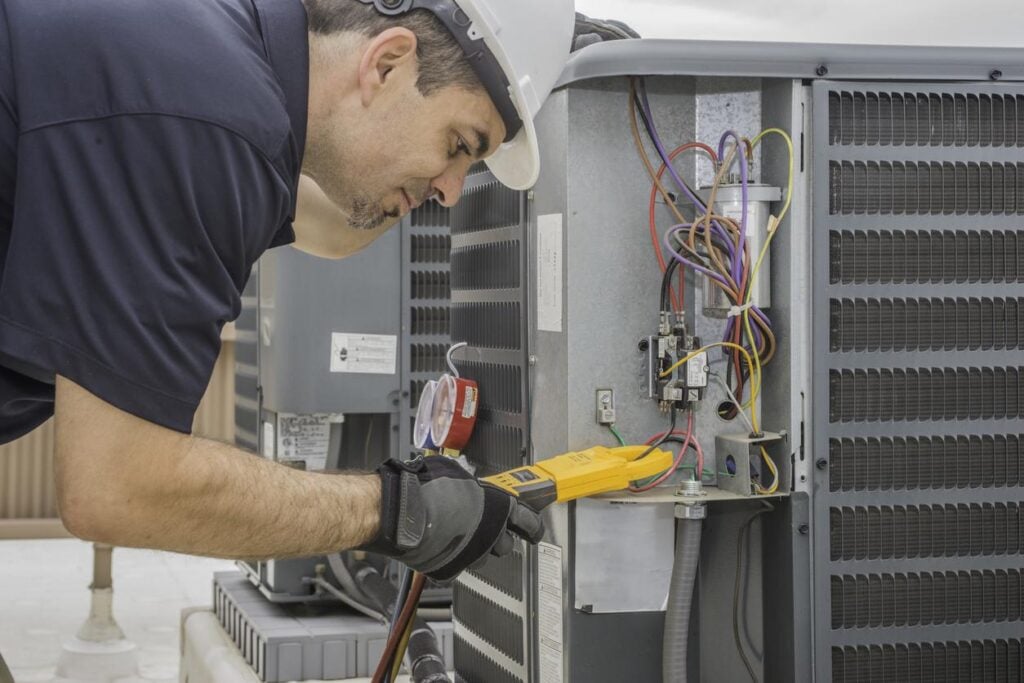
Symptoms tell you something is wrong. Diagnostics tell you what to fix. The gap between the two is where most homeowners overpay, because a misread symptom often leads to replacing parts that were never actually faulty.
Refrigerant Charge and Coil Performance
Refrigerant is not consumed during normal operation, so a low charge always means a leak somewhere in the closed loop. Technicians read two values to confirm this, superheat at the suction line and subcooling at the liquid line, and together they pinpoint whether the issue lies in the charge, the metering device, or the coil itself.
An outdoor coil packed with cottonwood seed or yard debris will mimic the same warning signs without any actual leak, which is why visual inspection comes before gauges.
Electrical Components That Predict Failure
The run capacitor is the cheapest part in the system and the one most likely to cause expensive damage when it weakens. A reading even 10 percent below its rated microfarad value forces the compressor into hard starts that shorten its life considerably.
- Run capacitor drift below the rated capacitance
- Contactor pitting that causes intermittent connection
- Control board relays showing heat discolouration
- Blower motor bearings with audible play
Ask any technician handling air conditioning repair in Calgary to show you the capacitor reading on their meter. Numbers do not lie, and a healthy capacitor is your best defence against compressor failure.
Ductwork and Static Pressure
High static pressure quietly destroys equipment. Undersized returns, crushed flex duct, or closed dampers force the blower to push against resistance it was never designed to handle. The result is shorter equipment lifespan and higher operating costs every single month.
Planning Installation and Ongoing Care for Long-Term Performance
Once repair invoices start stacking up, the math shifts toward replacement. Knowing where that line sits and what proper seasonal care looks like protects both your budget and your indoor comfort for years ahead.
When Repair Stops Making Sense
The industry rule of thumb is straightforward. If a single fix costs more than 50 percent of a new system, or the unit is past 12 years old with recurring faults, replacement usually wins on a five-year cost basis. Older R22 equipment faces a separate issue, since refrigerant prices for legacy units have climbed sharply as supply has dwindled.
| Scenario | Typical Cost Range | Recommended Action |
| Capacitor or contactor failure | $200 to $450 | Repair |
| Refrigerant leak, accessible | $600 to $1,400 | Repair if the unit is under 10 years old |
| Compressor replacement | $2,200 to $3,800 | Replace the full system |
| Evaporator coil, R22 system | $1,800 to $2,500 | Replace the full system |
What Quality Installation Requires
Proper AC installation in Calgary involves far more than swapping boxes. A correct job includes a Manual J load calculation, ductwork verification, line-set pressure testing, and a refrigerant charge weighed in by manufacturer specification rather than guessed from gauge readings.
- Matched indoor and outdoor units from the same manufacturer
- Properly sized line sets and electrical disconnect
- Condensate drain with safety float switch
- Programmable or smart thermostat commissioning
Annual tune-ups catch roughly 80 percent of failures before they happen, which is why HVAC services in Calgary are best booked in spring before peak demand hits. The result is equipment that runs efficiently for its full design life.
Smart Cooling Decisions for Reliable Home Comfort
Catching trouble early is what keeps a cooling system running through the hottest stretches of summer without surprise breakdowns. Pay attention to airflow, sounds, and energy bills, then act on those signals before secondary damage sets in.
Pairing routine seasonal care with timely diagnostics extends equipment life, lowers operating costs, and keeps your home reliably comfortable. When the symptoms point beyond a simple fix, qualified AC experts in Calgary bring the tools and training needed to resolve faults correctly the first time.