Easy Pawpaw Freezer Jam & Preservation Guide
When pawpaws are falling faster than we can eat them, this pawpaw freezer jam is one of my favorite ways to stretch that very short harvest. It keeps the fruit’s naturally creamy, tropical flavor front and center, and there is no canner or complicated equipment involved.
If you have been looking for a shelf-stable pawpaw jam recipe, I need to stop you right there: there is currently no research-tested home-canning recipe for pawpaw. That is exactly why this version belongs in the refrigerator or freezer. It is easy, delicious and—most importantly—based on the freezer-jam method recommended by food-preservation experts.
The Short Version
- Use only fully ripe American pawpaw pulp; discard every seed and all of the skin.
- Make freezer jam with the exact sugar and pectin measurements listed in the recipe card.
- Do not water-bath or pressure-can pawpaw jam without a research-tested recipe.
- Refrigerate the finished jam for up to 3 weeks or freeze it for up to 1 year.
- Once a container is opened, keep it refrigerated and use it within a few days.
What Does Pawpaw Jam Taste Like?
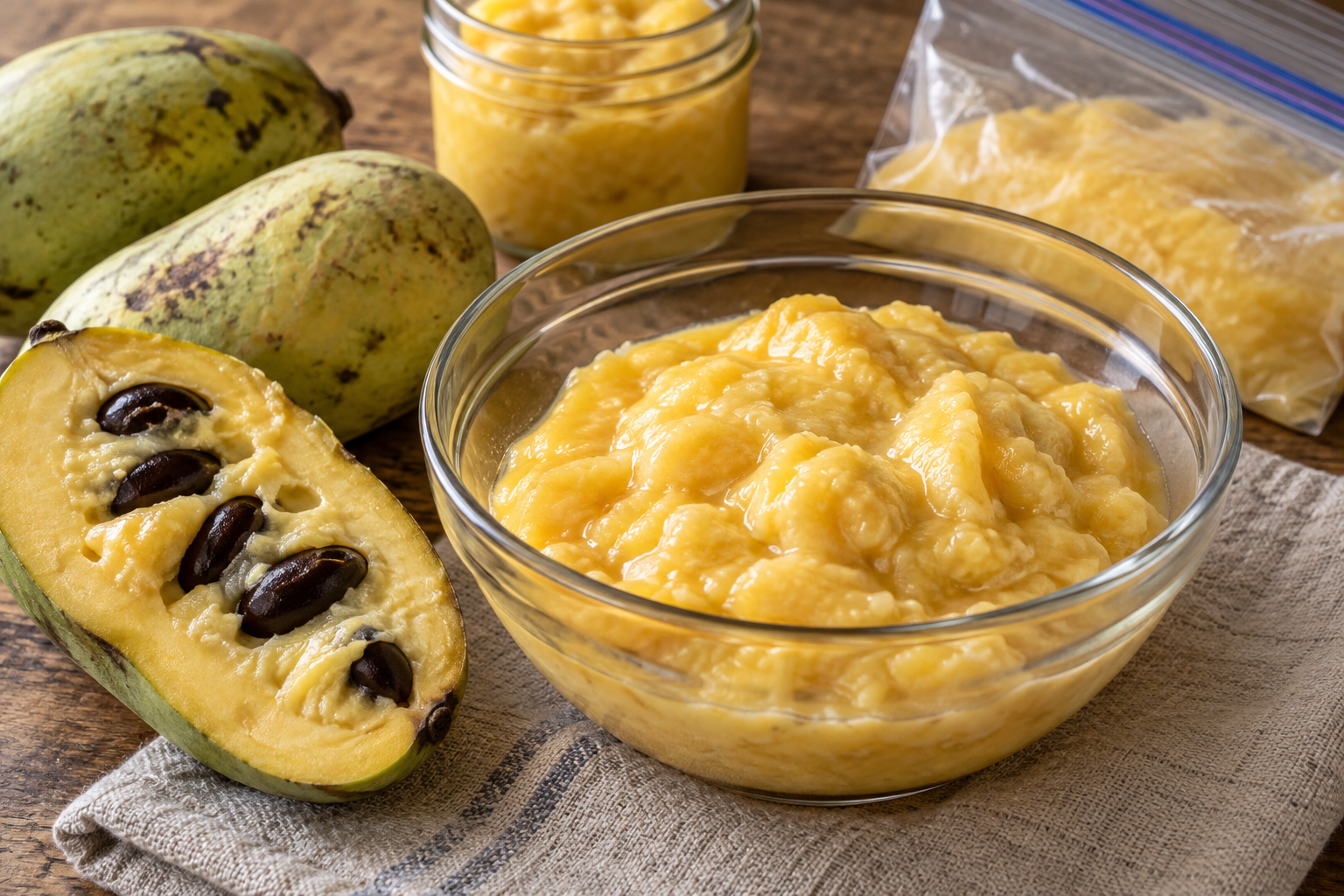
American pawpaws (Asimina triloba) have a soft, custardy texture and a flavor that reminds most people of banana, mango and vanilla. Every tree is a little different. Some fruit leans more banana-forward, while another tree may give you something almost like pineapple or melon.
As a jam, pawpaw stays mellow and creamy rather than becoming bright and tart like a berry preserve. It is lovely on toast, warm biscuits and cornbread, but I also like it stirred into plain yogurt or spooned over vanilla ice cream.
New to this native fruit? Start with my guide to foraging and identifying pawpaws in Pennsylvania, then read about when pawpaws are ripe and ready to pick. Pawpaws do not ripen well when picked hard, so starting with truly ripe fruit makes a big difference here.
Why This Is Freezer Jam, Not Canned Jam
I love putting up food as much as anyone, but canning is not a place for guesswork. Pawpaw is a low-acid fruit, and simply adding a squeeze of lemon juice does not turn an untested recipe into a safe canning recipe. Pressure canning is not a workaround either; safe processing requires a tested combination of ingredients, jar size, temperature and time.
Penn State Extension’s pawpaw guidance is clear: there are no research-based recipes for canning pawpaws. Their practical recommendation is to follow the directions on a box of powdered pectin for freezer jam, substituting pawpaw for the mashed fruit.
So this recipe is meant to be refrigerated or frozen. Please do not put these jars in a boiling-water bath, pressure canner or pantry. Freezing is not a consolation prize, either—it preserves pawpaw’s fresh flavor beautifully.
Choosing Pawpaws for Freezer Jam
The best fruit for jam should be fragrant and very soft, similar to a ripe avocado or peach. The skin may be blotchy or browned; that is normal for a ripe pawpaw. What matters is the flesh inside. It should smell sweet and look creamy yellow to golden, without fermented odors or signs of mold.
Wash the fruit before cutting it. Scoop the pulp away from the skin, remove every large dark seed and inspect the pulp one more time before measuring. Pawpaw seeds and skin should not be eaten.
If you are not ready to make jam on picking day, freeze the pulp first. My guide to freezing pawpaw pulp walks you through portioning, labeling and thawing it so none of that precious fruit goes to waste.
How to Make Pawpaw Freezer Jam
This recipe uses Sure-Jell Original powdered fruit pectin. The pectin mixture is briefly boiled with water, then stirred into the uncooked pawpaw and sugar. Measure everything before you begin and do not double the batch; jam sets most reliably when you make one batch at a time.
Pawpaw Freezer Jam
Ingredients
- 2 cups ripe American pawpaw pulp seeds and skin removed, mashed or pureed
- 4 cups granulated sugar
- 3/4 cup water
- 1 package Sure-Jell Original Premium Fruit Pectin 1.75 ounces

Instructions
- Rinse five 1-cup freezer-safe containers and their lids with boiling water. Dry thoroughly.
- Measure exactly 2 cups of pawpaw pulp into a large bowl. Stir in exactly 4 cups of sugar. Let stand for 10 minutes, stirring occasionally.
- Combine the water and powdered pectin in a small saucepan. Bring to a full rolling boil over high heat, stirring constantly. Boil for exactly 1 minute, continuing to stir.
- Immediately pour the hot pectin mixture into the fruit and sugar. Stir constantly for 3 minutes, or until most of the sugar is dissolved. A few sugar crystals may remain.
- Fill the prepared containers, leaving 1/2 inch of headspace for expansion. Cover and let stand at room temperature for 24 hours, or until set.
- Refrigerate for up to 3 weeks or freeze for up to 1 year. Thaw frozen jam in the refrigerator, then use the opened container within a few days.
Notes
Why the Pectin and Sugar Measurements Matter
Traditional powdered pectin is formulated to work with a specific amount of fruit and sugar. Cutting the sugar, swapping honey cup-for-cup or mixing brands can leave you with syrup instead of jam. Pectin products are not interchangeable, even when the boxes look similar.
If you prefer a less-sweet jam, use a pectin specifically labeled for low- or no-sugar recipes and follow that manufacturer’s freezer-jam directions. I would not improvise a reduced-sugar version with Original Pectin.
A soft set is not necessarily a failure. Pawpaw is naturally creamy, and this jam may be a little looser than commercial jelly. Give it the full 24-hour setting time before deciding whether it worked.
Storage and Thawing
Use straight-sided, freezer-safe containers and leave 1/2 inch of headspace so the jam has room to expand. After the 24-hour set, label each container with the name and date.
- Refrigerator: Store for up to 3 weeks.
- Freezer: Store for up to 1 year for best quality.
- After opening: Keep refrigerated and use within a few days.
- To thaw: Move a container to the refrigerator and let it thaw slowly. Stir before serving.
Freezing in several small containers is much more practical than using one large jar. You can thaw only what you will actually finish, and the rest stays protected in the freezer.
My Favorite Ways to Use Pawpaw Jam
- Spread it on buttered toast, biscuits, English muffins or cornbread.
- Swirl a spoonful into oatmeal, yogurt or cottage cheese.
- Layer it into a yogurt parfait with toasted nuts.
- Use a small spoonful as a filling for thumbprint cookies.
- Pair it with cream cheese on crackers.
- Warm it gently and spoon it over pancakes, waffles or vanilla ice cream.
And if you still have plenty of pulp in the freezer, save some for my pawpaw chiffon pie. It is one of the prettiest ways to show off pawpaw’s custardy texture.
Pawpaw Freezer Jam FAQ
Can I water-bath can pawpaw jam?
No. There is no research-tested home-canning recipe for pawpaw jam, and pawpaw is not acidic enough to safely can using an improvised water-bath method. Keep this recipe refrigerated or frozen.
Can I pressure-can pawpaw jam?
Not with this recipe. A pressure canner does not make an untested recipe automatically safe, and there is no validated processing time for pawpaw jam. Freeze it instead.
Can I use frozen pawpaw pulp?
Yes. Thaw the pulp in the refrigerator, stir it well and measure exactly 2 cups after thawing. If it smells fermented or seems spoiled, discard it.
Can I replace the sugar with honey?
Not as a one-for-one substitution in this recipe. Original powdered pectin needs the listed amount of sugar to set properly. For a honey-sweetened or lower-sugar version, choose a pectin made for low- or no-sugar recipes and follow its tested directions.
Why didn’t my freezer jam set?
The most common causes are inaccurate measurements, changing the sugar amount, using the wrong pectin or not boiling the pectin mixture for the full minute. It can also take the full 24 hours to reach its final set. Even if it stays soft, it is still delicious as a pawpaw sauce—just keep it refrigerated or frozen according to the same storage limits.
Is it safe to eat pawpaw seeds or skin?
No. Eat only the soft pulp. Remove and discard every seed and all of the skin while you prepare the fruit.
Want to keep exploring wild foods? Browse my complete foraging hub and bookmark the fall foraging guide for more seasonal finds.